

Government Shutdown 2025: How AI and Automation Help Businesses Stay Resilient
 Dec 19,2025
 By Priyanka Shinde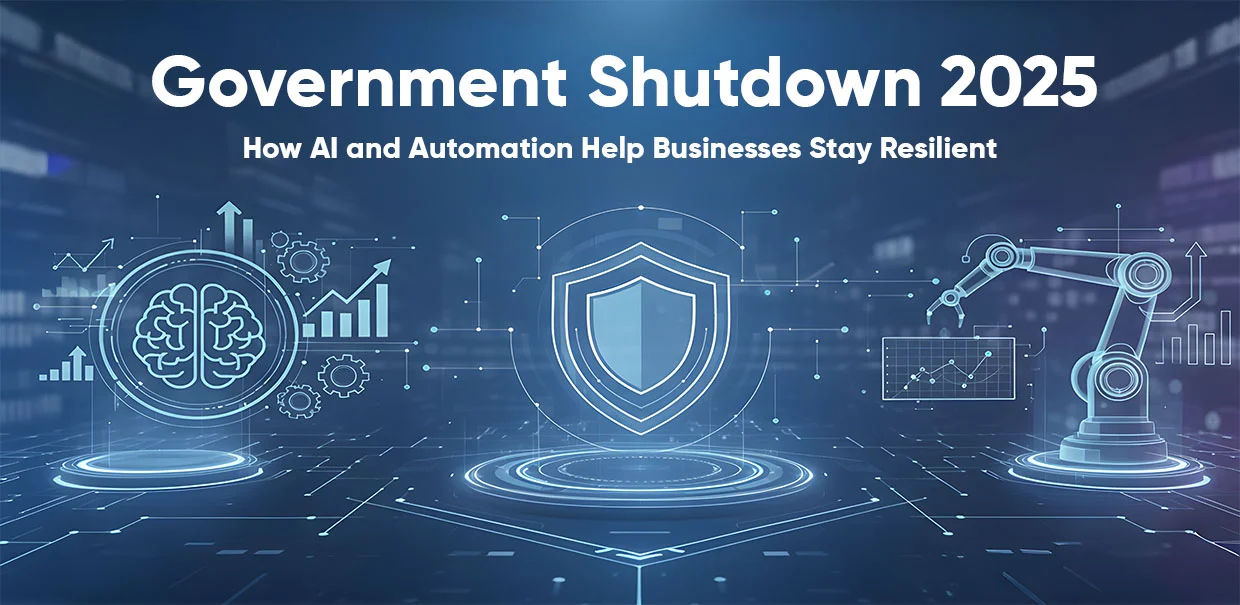
The Government Shutdown 2025 is sending ripples across the U.S. economy, leaving businesses, workers, and communities grappling with uncertainty. With federal services stalled and many agencies operating at limited capacity, companies are asking the critical question: how do we maintain resilience when the government shuts down?
The answer, increasingly, lies in AI and automation. By reducing dependency on manual processes and mitigating delays in government services, businesses are discovering that digital transformation can provide stability during political and operational disruptions.
Understanding the 2025 Government Shutdown
So, what exactly is happening in 2025? The U.S. federal government entered a partial shutdown following a budget impasse in Congress, leading to temporary furloughs for hundreds of thousands of federal employees. Essential services remain in place, but many agencies are either closed or running at minimal levels.
Businesses and citizens alike are asking: “Is the government still shutdown?” For now, the answer is yes. Negotiations continue, but analysts warn that prolonged closures could cost the economy billions each week.
And the question “when is the government shutdown over?” remains uncertain. Past shutdowns have ranged from a few days to over a month. The current stalemate may depend on political negotiations tied to broader fiscal debates, including elements linked to Project 2025 government shutdown proposals.
Who’s Affected by the Government Shutdown?
The impact stretches far beyond Capitol Hill. Here’s a look at who’s affected by the government shutdown in 2025:
- Federal Workers: Hundreds of thousands face furloughs or delayed paychecks.
- Small Businesses: Companies that rely on federal loans, permits, or contracts experience delays that directly affect revenue.
- Tourism & Outdoor Recreation: Questions like “Are state parks affected by the government shutdown?” and “Are game wardens affected by the government shutdown?” are common. The answer is yes; many national and state-managed parks reduce services or close altogether, while wildlife enforcement officers and game wardens face restricted operations.
- Contractors & Supply Chains: Businesses linked to defense, infrastructure, and research contracts face stalled payments and halted projects.
- Consumers: Reduced confidence and uncertainty often lead to lower spending, creating ripple effects across industries.
The broad scope of these disruptions highlights why organizations must look inward to strengthen their operational resilience.
The Hidden Cost of Shutdowns
Each day of a government shutdown adds to the economic burden. Analysts estimate that the Government Shutdown 2025 could cost billions in lost productivity and delayed output. While these figures often grab headlines, the true impact lies in the cascading delays for approvals, stalled projects, and reduced public services.
For businesses, the costs are both direct and indirect:
- Lost Time: Waiting for government permits or contract approvals.
- Lost Money: Missing out on federal funding or delayed payments.
- Lost Opportunities: Postponing expansions or new projects due to uncertainty.
This is where AI and automation play a transformative role, providing continuity and reducing reliance on systems vulnerable to shutdowns.
How AI and Automation Help Businesses Stay Resilient
In times of disruption, businesses that have embraced AI-powered solutions are proving more resilient. Here’s how AI and automation step in when the government steps back:
1. Maintaining Operations Without Manual Bottlenecks
Automated workflows reduce the need for approvals or checks that would otherwise be delayed. From HR management to supply chain tracking, AI helps businesses keep moving even when external agencies are stalled.
2. Enhancing Business Continuity Planning
AI-driven forecasting tools allow companies to model shutdown scenarios, assess risks, and adjust strategies in real time. This ensures businesses can adapt quickly to funding or regulatory delays.
3. Improving Workforce Productivity
During uncertain times, when hiring may slow down or government contracts freeze, automation can fill operational gaps. AI tools can handle repetitive tasks, allowing employees to focus on higher-value activities.
4. Data-Driven Decision Making
Uncertainty creates the need for fast, reliable decisions. AI analytics platforms help leaders analyze financial exposure, predict consumer behavior, and adjust strategies accordingly.
5. Strengthening Customer Experience
When disruptions create delays in service, AI chatbots and automated support systems ensure customer engagement doesn’t stop, keeping trust intact even during crises.
The Bigger Picture: Shutdowns and the Future of Work
Shutdowns like the one in 2025 raise a broader question: how can businesses design systems that withstand political or operational volatility?
AI and automation are not just temporary fixes; they are becoming core strategies for business continuity. Organizations investing in AI today are creating safeguards against future disruptions, whether they stem from political standoffs, economic uncertainty, or global crises.
Are Shutdowns the New Normal?
Political analysts suggest that budgetary standoffs may become more frequent as partisan divides deepen. Proposals such as the Project 2025 government shutdown agenda signal a shift in how fiscal policy debates are framed, potentially making shutdowns more common in the years ahead.
For businesses, this means preparing for shutdowns is no longer optional; it’s essential. AI and automation are the tools that allow enterprises to maintain momentum, even when Washington grinds to a halt.
Looking Ahead: When Will It End?
As negotiations continue, many are left wondering, “When is the government shutdown over?” While no clear timeline has been given, businesses are learning that waiting passively is not a strategy. Instead, the focus is shifting toward building resilience that outlasts political cycles.
Whether the shutdown ends tomorrow or stretches weeks longer, the lesson for 2025 is clear: those who embrace AI and automation will come out stronger.
The Government Shutdown 2025 is a stark reminder that businesses cannot control political disruptions, but they can control how prepared they are to withstand them.
By investing in AI and automation, companies reduce vulnerability, maintain operations, and continue delivering value to customers even amid uncertainty. From managing workflows to supporting employees and customers, AI ensures resilience when traditional systems falter.
Many forward-looking businesses are answering with a different approach; “How can we build smarter, better, and more resilient systems so shutdowns don’t destroy us down?”.

 Sep 22, 2026

