

MLOps: The Complete Guide to Modern Machine Learning Operations
 Dec 19,2025
 By Priyanka Shinde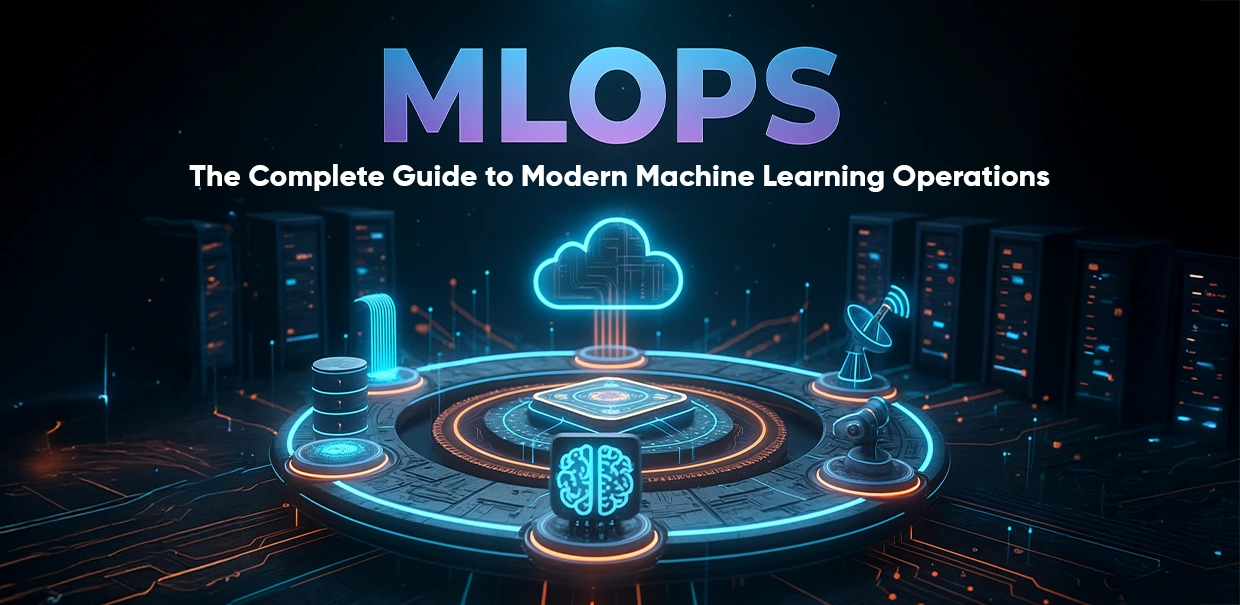
In recent years, the growing adoption of machine learning models has transformed industries, from healthcare and finance to retail and manufacturing. Yet, as organizations scale their AI initiatives, they are facing challenges in managing, deploying, and monitoring these models effectively. This is where MLOps comes into play.
What is MLOps?
At its core, MLOps is the practice of unifying machine learning development and operations to deliver reliable, scalable, and high-performing AI systems. If you are wondering, what is MLOps? Think of it as the “operating system” for machine learning applications.
MLOps (Machine Learning Operations) combines the principles of DevOps, data science, and automation to streamline the end-to-end lifecycle of AI and machine learning models. With the rise of enterprise adoption, demand for MLOps services, MLOps solutions, and even MLOps consulting services has surged, ensuring businesses can operationalize AI at scale with efficiency, security, and compliance.
It integrates workflows from data engineering, DevOps, and model management to ensure that models move seamlessly from experimentation to production. By enabling repeatable, auditable, and automated pipelines, MLOps helps enterprises avoid the common pitfalls of AI adoption, such as “model decay,” compliance risks, and high operational costs.
MLOps and Machine Learning Models
Building a machine learning model is only one step in the AI journey. The real challenge lies in deploying that model into production and keeping it effective over time. This is where MLOps proves invaluable.
MLOps streamlines the lifecycle of machine learning models through:
- Model Training: Automating data preparation, hyperparameter tuning, and training pipelines.
- Deployment: Seamlessly integrating trained models into enterprise applications and APIs.
- Monitoring & Maintenance: Continuously tracking performance to identify drift or anomalies.
For example, in the financial sector, an ML model used for fraud detection can be automatically retrained when new transaction patterns emerge, ensuring accuracy without manual intervention. Such workflows highlight how MLOps ensures models stay relevant and reliable at scale.
MLOps vs DevOps vs AIOps
Many organizations confuse MLOps with DevOps or even AIOps, but each serves a distinct purpose.
- MLOps vs DevOps: DevOps focuses on software development and deployment, while MLOps adds complexity with model training, data versioning, and monitoring ML-specific metrics. MLOps essentially extends DevOps practices into the AI domain.
- AIOps vs MLOps: AIOps (Artificial Intelligence for IT Operations) leverages AI to automate IT tasks such as incident management or log analysis. ML Ops, on the other hand, is about managing the lifecycle of ML models.
This differentiation matters because organizations need to know whether they require traditional DevOps, IT automation through AIOps, or the specialized support of MLOps.
MLOps Services and Solutions
As businesses scale AI initiatives, MLOps have become critical for success. These offerings include:
- Automation Tools: Platforms that automate training, deployment, and retraining cycles.
- Monitoring & Governance: Solutions that track metrics, flag drift, and ensure compliance with industry regulations.
- Scalable Infrastructure: Cloud-based services that provide compute power for large-scale model training.
For instance, a healthcare provider might use MLOps to ensure patient diagnosis models remain compliant with HIPAA regulations while improving accuracy through continuous monitoring. Similarly, e-commerce businesses rely on MLOps services to personalize customer experiences by retraining recommendation engines in near real-time.
MLOps Consulting Services
For many organizations, adopting MLOps isn’t straightforward. It requires changes in processes, tooling, and team structures. That’s why MLOps play a vital role.
Consultants help businesses by:
- Designing customized pipelines tailored to organizational needs.
- Ensuring compliance with data privacy and industry regulations.
- Training in-house teams on best practices.
- Recommending tools and infrastructure for sustainable scaling.
In industries with strict compliance requirements, such as finance or healthcare, MLOps ensure that models not only perform well but also adhere to ethical and legal standards. This reduces risks while accelerating time-to-value for AI investments.
Industry Events and MLOps Conferences
Keeping pace with the rapid evolution of AI requires constant learning, and MLOps conferences provide the perfect platform. These industry events bring together practitioners, researchers, and vendors to share insights, tools, and case studies.
Popular MLOps conferences showcase best practices in model monitoring, automation, and governance. They also foster networking opportunities, allowing businesses to connect with experts offering MLOps consulting services.
For professionals aiming to stay competitive, attending an MLOps conference can provide firsthand exposure to the latest advancements shaping the field.
The Future of MLOps
As AI adoption accelerates, the future of MLOps looks promising and dynamic. Emerging trends include:
- Integration with Automation: Tighter coupling with robotic process automation (RPA) and business workflows.
- Advanced Tooling: Smarter monitoring tools powered by generative AI to detect anomalies automatically.
- Cloud-Native Scaling: MLOps is becoming central to cloud strategies, enabling enterprises to scale AI globally.
- Compliance Automation: Enhanced governance features that simplify audits and ensure ethical AI use.
In the coming years, businesses will rely even more heavily on MLOps to stay competitive. By making AI deployments faster, safer, and more sustainable, MLOps is set to become the backbone of enterprise AI strategy.
In Summary
MLOps has emerged as a critical enabler for businesses seeking to operationalize AI effectively. From answering what MLOps is to exploring its role in managing machine learning models, we’ve seen how it differs from DevOps and AIOps and why MLOps are essential for enterprise success.
As industries continue to integrate AI into their workflows, adopting MLOps isn’t just a technical choice; it’s a strategic imperative. Organizations starting their journey should consider leveraging MLOps consulting services to design robust pipelines, ensure compliance, and maximize the value of their AI investments.
The future of AI is not just about building models; it’s about running them at scale, securely and reliably. And that is exactly what MLOps delivers.

 Sep 22, 2026

