

The Surprising Ways Generative AI Is Cutting Enterprise Costs
 Jan 07,2026
 By Priyanka Shinde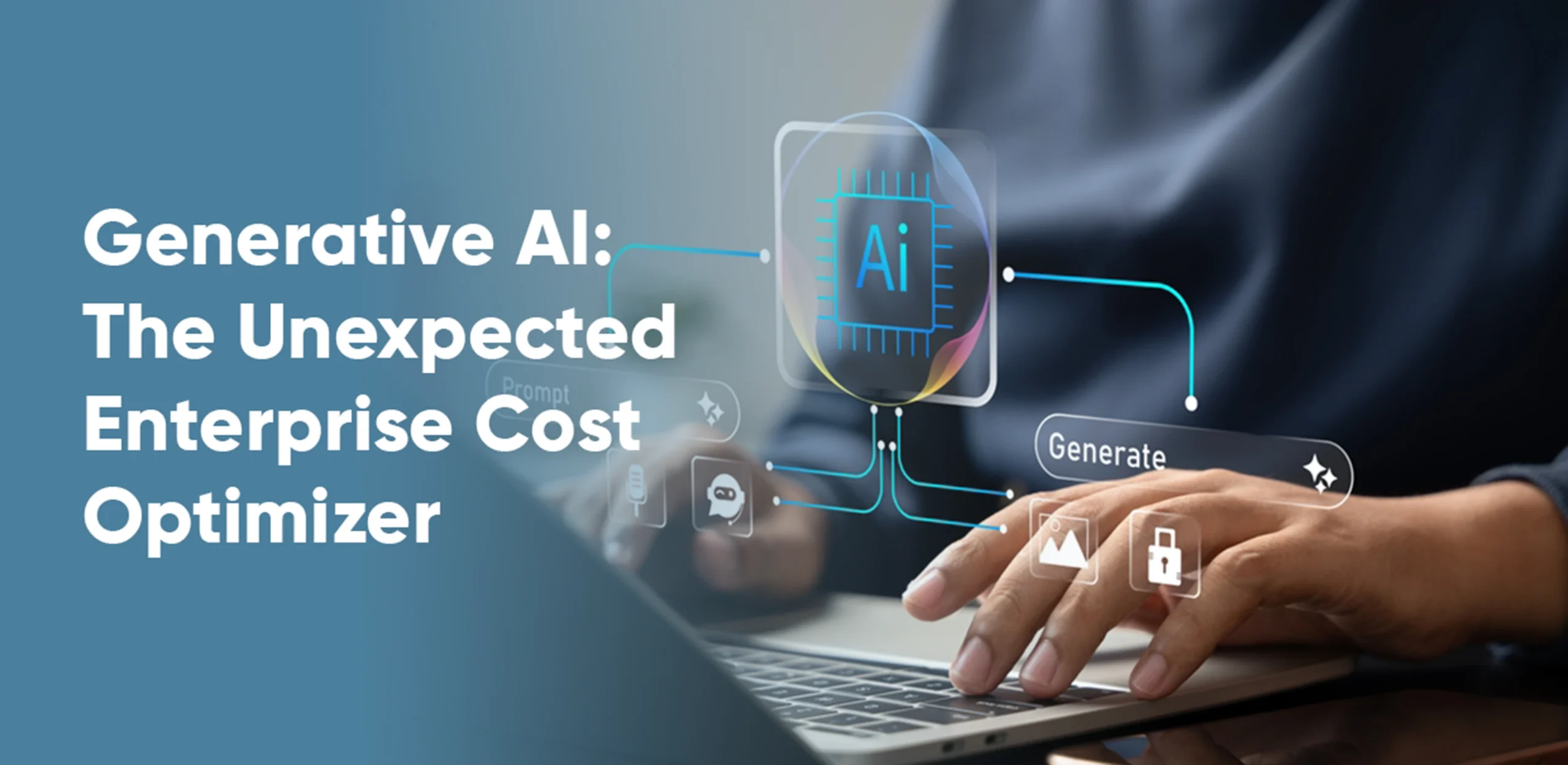
Introduction: AI That Saves More Than Time
Enterprises have always chased efficiency. For decades, organizations invested in software, outsourcing, and process improvement programs with one main goal: cutting operational costs. But today, a new player has entered the field: Generative artificial intelligence. What makes this technology different is not just its ability to generate text or images, but its capacity to reshape how work gets done across entire companies.
Unlike earlier automation tools that followed rigid rules, generative AI thinks in patterns. It reads, summarizes, responds, predicts, and even creates. And while the headlines in generative AI news often focus on futuristic possibilities, the real revolution is happening in accounting departments, IT teams, HR desks, and customer service centers, where budgets are tight, and expectations are high.
Across industries, Generative artificial intelligence is emerging as a practical cost-reduction engine. It is helping enterprises do more with fewer resources, higher accuracy, and dramatically lower turnaround times.
If you want to explore foundational insights on how enterprises are adopting AI-driven efficiencies, this resource offers helpful perspectives on enterprise automation strategies.
Understanding the Cost Challenge in Modern Enterprises
Running a large organization is expensive. Customer expectations are rising. Data volumes are exploding. Skilled labor costs continue to increase, and traditional software requires constant maintenance. Most enterprises struggle with:
- High support and service costs
- Long project delivery timelines
- Growing compliance overhead
- Expensive content and marketing budgets
- Inefficient document-heavy processes
Earlier generations of automation handled repetitive digital tasks, but they could not manage unstructured information. Emails, contracts, invoices, resumes, reports, and chat conversations still needed human effort.
Generative AI changes that equation.
Surprising Cost-Cutting Applications of Generative AI
The most surprising aspect of generative AI is where it delivers the fastest savings. Many leaders initially assume it is only useful for creative tasks. In reality, its biggest impact is operational.
Let’s look at the unexpected ways this branch of Generative artificial intelligence is cutting costs across enterprises.
1. Automating Customer Support and Service Operations
Customer support is one of the costliest functions in any enterprise. Large teams are required to answer common questions, handle tickets, and respond to emails. By deploying a RAG chatbot powered by Retrieval-augmented generation techniques, companies are reducing dependence on massive call-center workforces.
Generative AI systems can:
- Instantly respond to routine inquiries
- Summarize support tickets
- Draft accurate email replies
- Guide users through troubleshooting steps
- Provide 24/7 multilingual assistance
Because these systems learn from internal knowledge bases instead of relying solely on human agents, enterprises report up to 60% reduction in per-ticket costs. A well-designed AI assistant or RAG chatbot can handle thousands of conversations simultaneously without adding new headcount.
What once required a team of 50 support professionals can now be managed by a small group supervising AI-generated responses.
2. Transforming Software Development Economics
Perhaps the most dramatic savings are taking place inside IT departments.
Earlier, developing and maintaining software demanded large teams of programmers and testers. Now developers are using Generative artificial intelligence to generate code snippets, write documentation, and even create test scripts.
Generative AI helps cut costs by:
- Producing boilerplate code in seconds
- Debugging existing programs
- Converting legacy code into modern languages
- Automatically writing technical documentation
- Assisting with quality assurance
Projects that earlier took months are being completed in weeks. Enterprises are witnessing reductions in development expenses ranging from 30% to 45%. Licensing multiple tools and hiring external vendors becomes less necessary when AI can produce functional prototypes almost instantly.
Even junior programmers perform like seasoned professionals with AI copilots at their side.
3. Smarter Document Processing and Knowledge Management
Enterprises drown in documents. Contracts, invoices, proposals, regulatory filings, SOP manuals, the list never ends. Managing this information traditionally required armies of analysts.
Generative artificial intelligence can read unstructured documents and perform tasks that used to be impossible to automate:
- Extract key information from PDFs
- Summarize long reports
- Compare multiple contracts
- Validate invoices and purchase orders
- Generate structured data from messy inputs
Financial and legal departments are using AI tools to reduce manual review efforts. Instead of hiring additional process executives, organizations feed documents to AI models that instantly analyze them.
A Retrieval-augmented generation system connected to internal repositories allows employees to find precise answers without wasting hours searching through folders. This capability alone is saving millions in productivity costs.
4. Redefining Marketing and Content Expenses
Marketing is another area where generative AI is delivering surprising ROI.
Enterprises typically spend heavily on agencies, freelancers, designers, and content studios. Generative artificial intelligence now handles a large portion of that creative workload:
- Blog writing
- Social media posts
- Ad copy variations
- Product descriptions
- Image and video concepts
Earlier, a single campaign demanded weeks of brainstorming and external spending. AI generates hundreds of content options within minutes, reducing creative production costs by nearly 50%.
Teams no longer need to outsource every small requirement. AI becomes an always-available content partner that works at the speed of thought.
5. Streamlining HR and Recruitment Processes
Human Resources departments handle one of the most labor-intensive workflows—recruitment.
Generative artificial intelligence is helping enterprises:
- Screen resumes
- Draft job descriptions
- Generate interview questionnaires
- Summarize candidate profiles
- Communicate with applicants
Instead of large HR coordination teams, AI tools perform the first level of evaluation. With systems trained on company policies and historical hiring data, organizations are reducing recruitment operational expenses and improving hiring speed.
The savings appear not only in reduced HR effort but also in faster placement of candidates, which lowers the hidden cost of vacant positions.
6. Optimizing Supply Chain and Procurement
Enterprises spend enormous capital on purchasing and vendor management. AI is beginning to influence these decisions as well.
Generative AI models can analyze historical procurement data and help by:
- Generating supplier comparison reports
- Drafting RFQs and RFPs
- Predicting demand fluctuations
- Automating vendor communications
- Summarizing logistics documents
These capabilities reduce dependency on external consultants and cut the time employees spend on negotiations and follow-ups.
Even small improvements in procurement efficiency translate into large financial savings for global enterprises.
7. Risk Management and Fraud Detection
Compliance and risk teams often expand every year as regulations grow. Generative artificial intelligence is enabling a learner approach.
AI systems review transactions, reports, and communications to detect anomalies. They can generate risk summaries and highlight potential fraud indicators. Instead of manually checking thousands of records, a small expert team validates AI-flagged cases.
The result is lower operational risk at a fraction of the traditional monitoring cost.
Real-World ROI: Accuracy Meets Efficiency
What truly drives cost reduction is accuracy. AI-generated outputs reduce human errors in documents, payments, and customer interactions. Fewer mistakes mean:
- Less rework
- Lower penalty costs
- Reduced customer churn
- Faster decision-making
Enterprises are discovering that generative AI is not replacing humans; it is amplifying them. When integrated properly into daily workflows, it becomes one of the most powerful cost-saving technologies organizations have ever used.
Staying Updated With Generative AI News
The AI landscape evolves quickly. New models and tools appear almost every week, as highlighted in ongoing generative AI news. Enterprises that keep track of these developments gain a strategic advantage.
Cost-cutting possibilities expand as technology improves. What seems innovative today will be standard practice tomorrow. Leaders who stay curious and informed are the ones who unlock the highest ROI.
Implementation Considerations
While the savings are impressive, success depends on thoughtful adoption:
- Identify high-volume processes first
- Integrate AI with existing enterprise systems
- Use structured prompts and governance
- Train teams to supervise AI outputs
- Protect sensitive corporate data
Generative artificial intelligence works best when guided by clear objectives. Enterprises should treat it as a long-term transformation program rather than a short experiment.
Conclusion: The New Cost-Reduction Engine
The cost pressures on enterprises are not going away. But the tools to fight them have changed. Generative AI is delivering savings in areas no one expected: customer support, software development, HR operations, marketing, and supply chain management.
What began as an exciting topic in generative AI news has matured into a real enterprise asset. Companies across the globe are demonstrating that Generative artificial intelligence can enhance accuracy while reducing costs.
The most surprising part?
We are only at the beginning.
Over the next few years, generative AI will quietly integrate itself into every corner of enterprise operations, transforming curiosity into capability and capability into measurable ROI. Enterprises that embrace this shift today will lead the next generation of efficient, intelligent, and cost-optimized organizations.

 Sep 22, 2026

