

From Molecules to Miracles: How AI Is Speeding Up Drug Discovery
 Dec 22,2025
 By Priyanka Shinde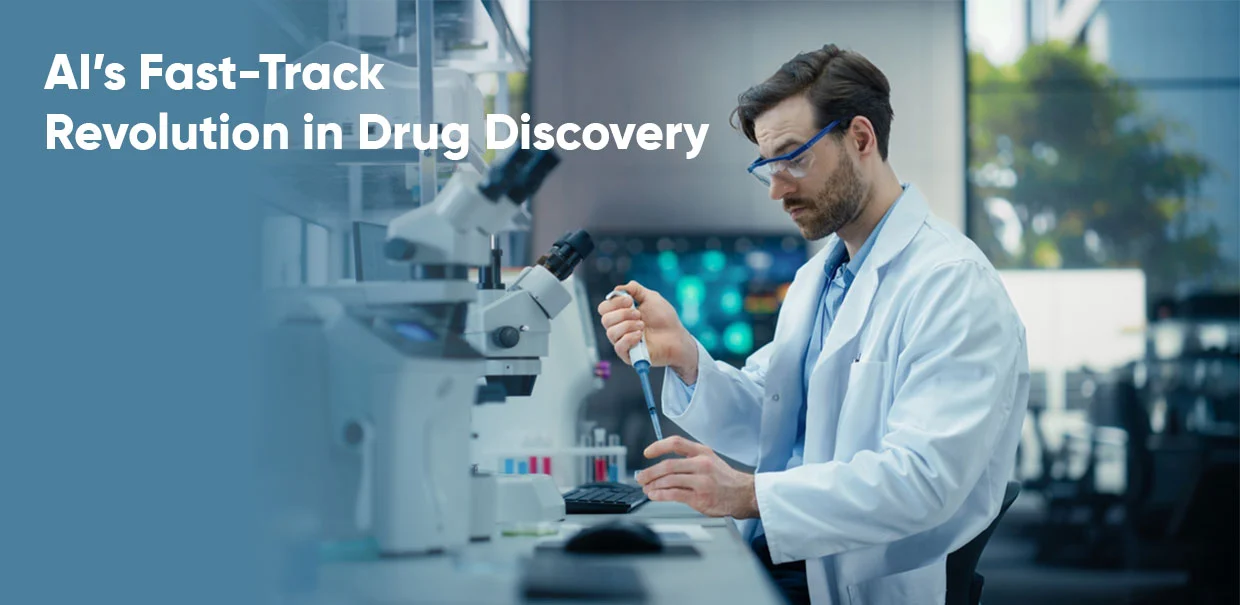
Introduction – The Breakthrough Era of AI in Pharma
Drug discovery has always been a high-stakes, high-cost, and painfully slow process. A single new drug can take 10–15 years and billions of dollars before ever reaching a pharmacy shelf. But today, something remarkable is happening: AI is rewriting the rules of pharmaceutical innovation.
From predicting molecule behavior to automating lab experiments, AI is turning years of research into months, and in some cases, even weeks. It’s not just speeding up science; it’s paving the way for biomedical miracles.
So, how is AI doing the impossible? Let’s break it down.
Understanding How AI Transforms Drug Discovery
Predictive Modeling for Faster Discovery
Instead of testing thousands of compounds manually, AI predicts which molecules are most likely to succeed. This drastically cuts time and cost by eliminating dead ends early.
Designing Molecules with AI
AI doesn’t just analyze molecules, it creates them. Modern generative AI tools can design novel compounds with specific characteristics, something humans would take years to do.
AI in Early-Stage Drug Screening
Using massive datasets and simulations, AI screens compounds at lightning speed, identifying top candidates long before physical testing begins.
The Role of Machine Learning in Pharma Innovation
Deep Learning for Complex Molecular Behavior
Deep learning models understand patterns invisible to humans, like how proteins fold or how molecules might interact in the body. This helps scientists predict drug behavior with incredible accuracy.
How ML Minimizes Uncertainty in Clinical Trials
AI analyzes patient data to identify who will respond best to a drug. This reduces risk and increases the chances of successful clinical outcomes.
Reducing Costs with Automation
By automating routine experiments, AI-driven systems reduce labor costs and free human researchers to focus on creativity and decision-making.
How AI Speeds Up Each Stage of Drug Development
Target Identification
AI scans medical literature, biological data, and clinical studies to pinpoint promising disease targets faster than any manual analysis.
Hit Identification and Validation
Once targets are identified, AI quickly identifies or designs molecules that can interact with them, analyzing chemical libraries that would take humans months to review.
Preclinical and Clinical Acceleration
AI models predict toxicity, side effects, bioavailability, and more, helping eliminate unsafe candidates early and fast-tracking the best ones.
Real-World Examples of AI Success in Drug Discovery
AI-Designed Drugs Entering Clinical Trials
Several AI-generated drug candidates have already reached human trials—proof that AI is not just theoretical, but truly transforming medicine.
Pharma Giants Adopting AI-Driven Labs
Companies like Pfizer, Roche, and AstraZeneca now use AI systems for everything from molecule design to predictive simulations.
Startups Driving Innovation
AI-focused biotech startups, armed with cutting-edge algorithms, are partnering with global pharma firms to accelerate discovery across multiple therapy areas.
Benefits of AI in Drug Discovery
Faster Research Cycles
AI cuts discovery time by up to 70%, bringing new treatments to patients far sooner.
Higher Accuracy with Fewer Failures
By predicting outcomes early, AI reduces expensive late-stage failures, saving millions.
Personalized Medicine Possibilities
AI can analyze genetic and lifestyle data to design drugs tailored to individual patients, transforming the future of healthcare.
Challenges and Limitations
Data Quality Issues
AI is only as good as the data it learns from. Poor or limited datasets can slow progress.
Ethical & Regulatory Constraints
Regulatory bodies must carefully evaluate AI-generated drugs, which can lengthen approval time.
Human-AI Collaboration Concerns
Researchers worry about over-reliance on AI, but the key is partnership, not replacement.
The Future of AI in Drug Discovery
Autonomous Labs
Robots guided by AI may soon run entire labs, from experiments to analysis, 24/7.
AI-Powered Digital Twins
Imagine testing drugs on a virtual model of a human body. That’s exactly what AI digital twins are making possible.
Instant Molecule Generation
Future AI systems could generate and validate new molecules in minutes, revolutionizing how fast cures are found.
Conclusion
AI isn’t just improving drug discovery, it’s reinventing it. What used to take decades can now happen in a fraction of the time. From identifying targets to creating new molecules and predicting clinical outcomes, AI is becoming the ultimate research partner.
As the technology continues to evolve, we’re moving into a future where life-saving drugs are discovered faster, more accurately, and more affordably, turning scientific dreams into medical miracles.
FAQs
1. How does AI reduce drug discovery time?
AI predicts promising molecules and eliminates low-performing candidates quickly, speeding up the entire discovery process.
2. Is AI replacing scientists in pharma?
No. AI assists scientists by automating repetitive tasks and enhancing decision-making.
3. Can AI design brand-new drugs?
Yes! Generative AI models can create completely new molecules with desired properties.
4. What are the risks of AI in drug discovery?
Data quality issues, regulatory hurdles, and ethical concerns are the major challenges.
5. What’s the future of AI in pharma?
Expect autonomous labs, AI-designed drugs, and faster-than-ever discovery cycles.

 Sep 22, 2026

