

AI in Quality Control: Fewer Defects, Greater Precision
 Dec 22,2025
 By Priyanka Shinde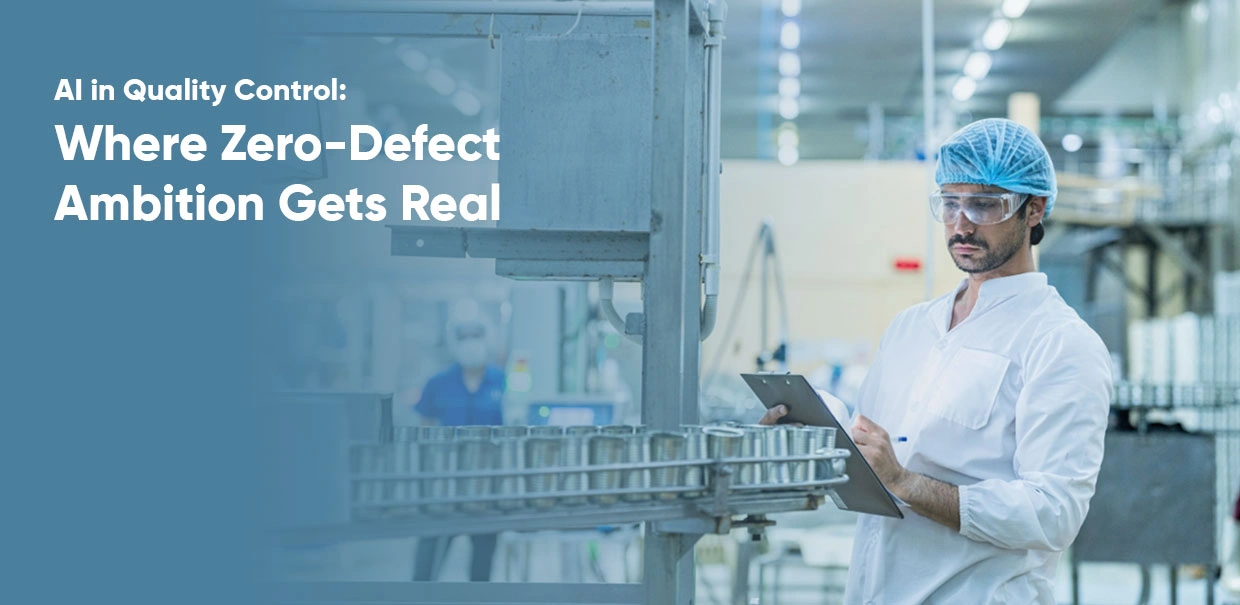
AI in Quality Control: Fewer Defects, Greater Precision
Quality control (QC) has always been the backbone of manufacturing, but let’s be honest, traditional QC methods can be slow, inconsistent, and expensive. Human inspectors get tired, machines drift out of calibration, and visual checks may miss tiny defects that later turn into costly recalls or customer complaints.
But today, something remarkable is happening.
AI is stepping into the QC process not to replace human expertise, but to enhance it with accuracy, speed, and consistency that were previously unimaginable. From real-time defect detection to 100% product inspection, AI is helping manufacturers deliver products with fewer errors, better precision, and greater customer trust.
Suppose you’ve ever wondered how factories are producing flawless products at scale, or why so many companies are investing heavily in AI-powered quality systems. In that case, this blog will give you the full picture.
Let’s dive into how AI is reshaping quality control and why this shift matters for the future of manufacturing.
Why Traditional Quality Control Struggles Today
Most industries still rely on manual, sample-based inspections. While effective to an extent, this approach comes with several challenges:
1. High Chance of Human Error
Even the most skilled inspectors can miss flaws, especially when they look at thousands of units every day. Fatigue, distraction, and cognitive bias play a big role.
2. Time-Consuming and Labor-Heavy
Manual inspection slows down production lines and demands a large workforce, making it expensive and inefficient.
3. Inconsistency in Results
No two inspectors assess defects in the same way, which leads to inconsistent quality standards.
4. Limited Detection Capabilities
Tiny cracks, micro-defects, or internal flaws are often invisible to the human eye or basic sensors.
As production complexities rise and customer expectations grow, companies can no longer rely solely on traditional QC.
This is where AI-driven quality control comes into the spotlight.
How AI Is Transforming Quality Control
AI is not just improving QC; it’s redefining it.
Here’s how modern manufacturing plants are using AI to achieve precision, speed, and reliability like never before.
1. Computer Vision for Visual Inspection
Computer vision, powered by machine learning, can scan products at incredible speeds—often inspecting hundreds of items per minute.
Key advantages include:
- Detects defects invisible to the human eye
- Ensures consistent results across all product batches
- Works 24/7 with zero fatigue
- Captures real-time data for performance optimization
AI-powered cameras can spot surface scratches, shape deviations, color inconsistencies, alignment issues, and more. These systems learn continuously, becoming more accurate over time.
2. Predictive Quality Analytics
Imagine knowing a defect will occur before it even happens.
AI algorithms analyze historical data, machine performance, environmental conditions, and production patterns to predict when quality standards might be compromised.
This helps companies:
- Reduce machine downtime
- Prevent quality failures proactively
- Minimize costly rework and scrap
- Maintain 100% process stability
Predictive analytics turns quality control from a reactive function into a proactive one.
3. Automated Defect Classification
AI doesn’t just detect defects it categorizes them instantly.
For example:
- Types of cracks
- Types of material deformations
- Types of assembly errors
This is crucial for root-cause analysis. Manufacturers can identify exactly why defects are occurring and fix the process upstream.
4. Robotics + AI = Precision Manufacturing
Robotic arms paired with AI vision systems can inspect components with unmatched accuracy. These robots can measure dimensions, align products perfectly, and even correct minor defects on the fly.
Benefits include:
- Faster quality checks
- Higher accuracy in measurements
- Less reliance on manual labor
- Improved consistency in repetitive tasks
AI-powered robots are now common in automotive, electronics, and medical device manufacturing.
5. AI for Non-Destructive Testing (NDT)
AI is enhancing NDT techniques such as:
- X-rays
- Ultrasound
- Thermal imaging
- CT scans
These tools help identify internal defects without damaging the product. AI models can analyze massive amounts of imaging data faster and more accurately than traditional methods.
6. Real-Time Monitoring on the Production Line
AI sensors installed throughout production lines can monitor:
- Temperature
- Pressure
- Movement
- Vibration
- Assembly sequences
If anything deviates even slightly from the expected pattern, AI raises an immediate alert.
This ensures that products maintain consistent quality from the very beginning of production.
The Business Benefits of AI in Quality Control
Organizations using enterprise AI solutions have reported significant improvements in defect reduction and quality consistency. Implementing AI in QC delivers powerful outcomes for manufacturers.
Significant Reduction in Defects
AI consistently catches more flaws than human inspectors.
Higher Customer Satisfaction
Fewer defective products mean happier customers and fewer returns.
Cost Efficiency
Companies save money through:
- Reduced scrap
- Reduced rework
- Lower labor costs
- Fewer recalls
Faster Production Cycles
AI enables real-time inspection, eliminating bottlenecks.
Better Regulatory Compliance
AI systems maintain detailed logs and quality records—making audits easier.
Ability to Scale Production
Even if production volumes double, AI systems can handle the workload with ease.
Industries Benefiting the Most from AI in QC
AI-powered quality control is being adopted across almost every sector, but some industries have seen especially impressive results:
Automotive Manufacturing
Spotting micro-defects in engines, paint layers, and assembly lines.
Electronics
Detecting PCB defects, solder errors, and circuit inconsistencies.
Pharmaceuticals
Ensuring tablet uniformity, packaging integrity, and contamination-free production.
Aerospace
Extreme precision in component testing and structural inspection.
Food & Beverage
Checking labeling accuracy, packaging quality, and product freshness.
Textiles
Identifying color mismatches, stitching flaws, and fiber inconsistencies.
AI adapts quickly, making it suitable for both high-volume factories and smaller production setups.
Challenges in Adopting AI for Quality Control
While AI brings tremendous potential, organizations do face challenges such as
1. Initial Implementation Cost
Sophisticated vision systems and AI infrastructure require upfront investment.
2. Need for High-Quality Training Data
AI models need accurate, labeled data to perform effectively.
3. Workforce Training
Teams must learn how to operate and maintain AI systems.
4. Integration with Legacy Systems
Older machines may require upgrades or IoT connectivity.
However, companies that overcome these barriers experience long-term gains far outweighing the costs.
The Future of AI in Quality Control
The next decade will bring even more exciting advancements:
Hyper-Automated QC
Fully automated production lines capable of 100% inspection.
AI Agents for Real-Time Decision-Making
Autonomous AI systems that make instant adjustments without human intervention.
Self-Learning QC Models
Systems that improve without frequent retraining.
Augmented Reality for QC Teams
Smart glasses powered by AI to assist inspectors in real time.
AI is moving QC from a cost center to a competitive advantage, helping businesses deliver flawless products faster and more efficiently.
Final Thoughts
AI in quality control is not just a trend; it’s a revolution.
Companies that adopt AI-driven QC experience:
- Fewer defects
- Greater precision
- Lower costs
- Faster production
- Higher customer satisfaction
Whether you run a large factory or a small production unit, adding AI to your quality control process can transform how your products are made and perceived.

 Sep 22, 2026

