


Why Smart CFOs Are Replacing Spreadsheets With Automated Workflows
 Dec 19,2025
 By Priyanka Shinde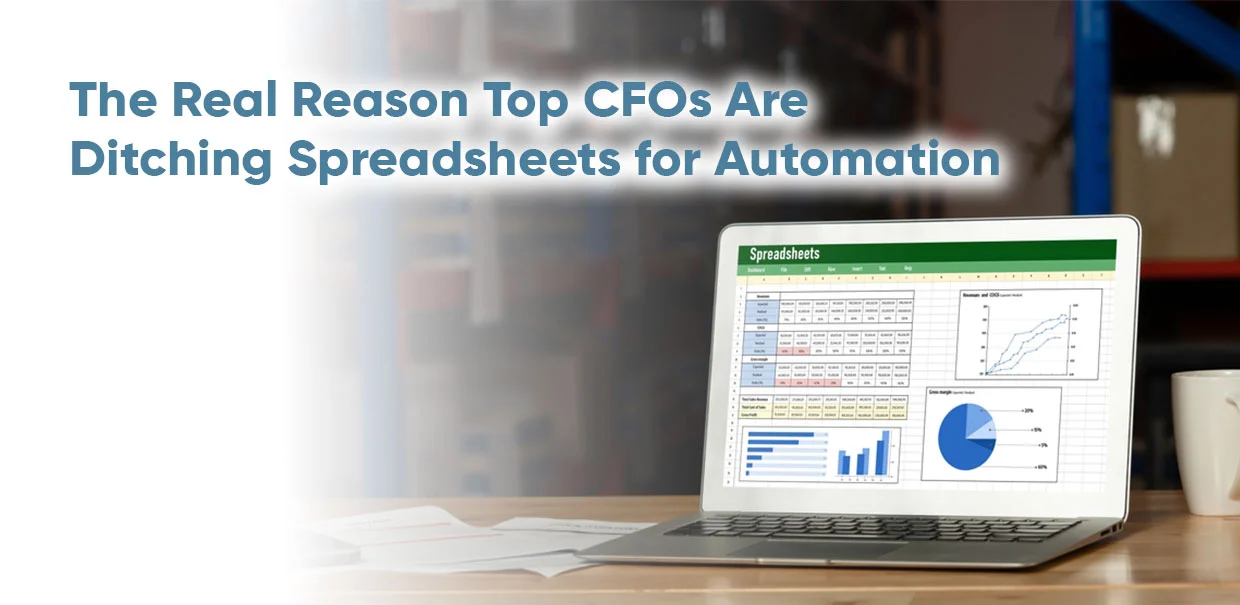
Introduction
For decades, spreadsheets were the loyal workhorses of finance teams. They organized budgets, tracked cash flow, and assisted businesses in planning for growth. But today’s finance leaders are facing challenges that spreadsheets simply weren’t built to handle: faster reporting cycles, massive data streams, compliance pressure, and the constant need for real-time insights.
That’s why a growing wave of smart CFOs is quietly moving away from spreadsheets and adopting automated workflows. And the shift is not just about saving time; it’s about transforming finance into a strategic powerhouse that can guide the entire organization more effectively.
If you’re still undecided about automation or wondering what’s driving this change at the leadership level, this blog breaks it down in a way that’s practical, relatable, and actionable.
The Quiet Crisis With Spreadsheets That CFOs Can No Longer Ignore
Spreadsheets are familiar, easy to build, and great for quick calculations. But behind the scenes, they carry risks that get worse as the business scales:
1. Errors Are Almost Guaranteed
Over 80% of spreadsheets contain errors. A single wrong formula can cause misreported revenue, compliance issues, or decisions based on inaccurate data. And these mistakes often go unnoticed until it’s too late.
2. Spreadsheets Don’t Scale
As businesses grow, so does the complexity of financial processes. Monthly reporting becomes a burden. Forecasting takes too long. Teams rely on endless versions of files—v5, v6_final, and v6_final_updated.
CFOs are realizing: If your team spends more time collecting data than analyzing it, growth becomes slower and more expensive.
3. Zero Real-Time Visibility
Spreadsheets live on desktops or shared drives, not inside systems that update automatically. By the time numbers are compiled, the data is already outdated, making strategic decisions much harder.
4. Compliance Becomes a Risk
Audit trails and version control in spreadsheets are weak. Finance leaders are under pressure from regulators, investors, and boards to improve accuracy and transparency. Manual tools can’t keep up with modern compliance expectations.
Enter Automated Workflows: The CFO’s New Strategic Advantage
Automated workflows solve problems not just at the operational level but also at the strategic level, where CFOs work every day.
Instead of chasing numbers, automation helps finance teams trust the numbers and, more importantly, act on them faster.
Here’s why CFOs are making the switch:
1. Real-time data instead of manual data gathering
Automation connects different systems, ERP, CRM, billing, and procurement, so data flows continuously and accurately. No more export/import loops. No more late-night copy-paste marathons.
CFOs finally get what spreadsheets could never provide:
✔ A single source of truth
✔ Dashboards updated in real time
✔ Instant access to financial health metrics
2. Financial closes that take days, not weeks
Month-end and quarter-end closes are notoriously taxing. Automated workflows streamline:
- Reconciliations
- Journal entry creation
- Consolidations
- Report generation
Instead of wrestling with spreadsheets, teams can close books faster and shift their focus to analysis and strategic planning.
3. Forecasting becomes smarter and more accurate
With automation, forecasting tools use historical data, real-time inputs, and even predictive modeling. CFOs can simulate multiple business scenarios instantly, something spreadsheets struggle to handle without crashing or becoming too complex.
The result?
Better decisions with a fraction of the effort.
4. Compliance and audits become easier
Automated workflows maintain logs, approvals, timestamps, and access control, items auditors love, and spreadsheets can’t guarantee.
When compliance becomes built-in, CFOs spend less time preparing for audits and more time planning the future.
5. Teams free up hundreds of hours
Perhaps the biggest win is time. Finance professionals want to do meaningful work, not repetitive tasks. CFOs who adopt automation report:
- 40–60% reduction in manual work
- Less burnout
- Higher team satisfaction
- Faster execution cycles
These hours saved aren’t just operational wins; they turn finance into a department that influences growth, not just records it.
The Human Side: Why CFOs Are Emotionally Done With Spreadsheets
Beyond efficiency, there’s a human reason behind this shift.
Spreadsheets create stress.
Automation removes it.
CFOs are tired of firefighting, chasing file versions, worrying about errors, and carrying the weight of financial accuracy alone. Automated workflows bring peace of mind, a priceless benefit that spreadsheets could never offer.
Finance leaders also want their teams to thrive. They’re investing in automation because they know:
- Talented analysts shouldn’t waste hours formatting cells.
- Leaders shouldn’t second-guess numbers.
- The business shouldn’t wait for manual processes.
Automation is no longer a luxury. It’s becoming the new standard for modern finance teams everywhere.
What CFOs Are Automating First
If you’re wondering where smart CFOs typically begin, here are the top automation priorities:
✔ Accounts payable
✔ Accounts receivable
✔ Expense management
✔ Financial reporting
✔ Cash flow insights
✔ Procurement and approvals
✔ Reconciliations
✔ Budgeting & forecasting
Many begin with one or two processes, then expand as they see time savings and accuracy improvements.
A Realization Many CFOs Share
Most CFOs who adopt automated workflows say:
“We should have done this years ago.”
Not because spreadsheets are bad, but because the business has outgrown them.
Automation brings a level of clarity, speed, and convenience that spreadsheets simply cannot match in 2025. And as competition tightens, data speeds up, and compliance rules expand, the companies that thrive will be the ones whose finance teams operate without friction.
The Future of Finance Isn’t Manual—It’s Intelligent
Finance is no longer just about managing numbers; it’s about powering decisions. Automated workflows are helping CFOs:
- Predict growth
- Control risk
- Optimize costs
- Support the CEO with stronger insights
- Build a finance team that operates with confidence
If spreadsheets were the tools of yesterday, automated finance systems are the engines of tomorrow.
To explore how organizations are modernizing operations with automation, here’s a helpful resource:
Modern Automation Insights.
Final Thoughts
Smart CFOs aren’t abandoning spreadsheets because they dislike them—they’re evolving beyond them. They’re choosing tools that match today’s pace of business and empower their teams to deliver more value.
Automation isn’t just an upgrade.
It’s the new foundation of high-performing finance organizations.
If you’re a CFO or aspire to work like one, the question isn’t “Should I replace spreadsheets?”
It’s “How much longer can I afford not to?”

 Sep 22, 2026

