

The Smart Supply Chain: How AI Is Eliminating Delays and Stockouts
 Dec 10,2025
 By Priyanka Shinde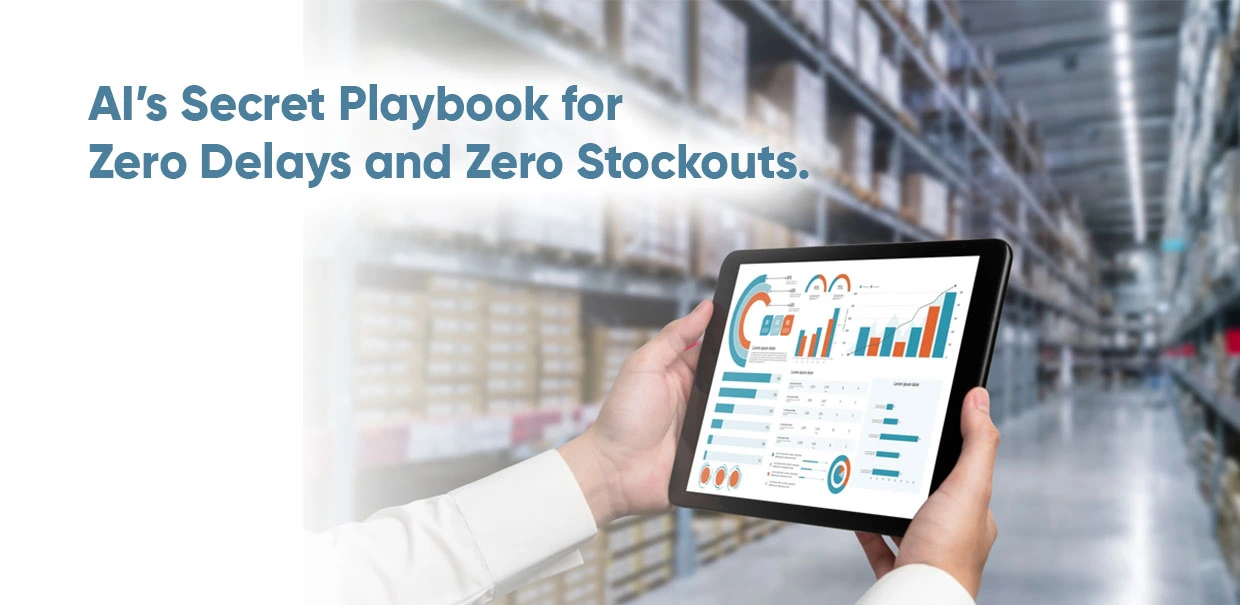
If there’s one thing today’s businesses agree on, it’s this: customers expect everything faster—faster delivery, faster order updates, and faster problem resolution. Yet many supply chains still rely on outdated systems that crumble under unpredictability, causing delays, stockouts, and unhappy customers.
But here’s the surprising twist.
The biggest supply chain gains today aren’t coming from more warehouses or more trucks; they’re coming from intelligent systems that think, predict, and adapt on their own.
This is the era of the smart supply chain, powered by AI. And the companies adopting it? They’re not just keeping shelves full; they’re operating at a level of efficiency that was unthinkable just a decade ago.
Why Traditional Supply Chains Are Struggling
Most supply chains were designed for stability. But modern markets are anything but stable.
- Sudden spikes in demand
- Unpredictable supplier delays
- Transportation bottlenecks
- Global disruptions
- Human errors in planning
With manual forecasting and reactive operations, businesses often find themselves either overstocked (cash trapped in inventory) or stocked out (customers lost to competitors). Both are equally damaging.
Enter AI, not just as a tool but as a strategic advantage.
AI Turns Supply Chains From Reactive to Predictive
The magic of AI in supply chain management lies in its ability to anticipate problems before they occur. Unlike traditional systems, AI doesn’t rely on static reports. It learns from sales history, market signals, weather patterns, manufacturing data, and even social trends.
Here’s how AI transforms operations:
1. Demand Forecasting That Actually Sees the Future
Forecasting has always involved guesswork. AI removes the guesswork entirely.
Machine learning models analyze data at a scale no human team could achieve—millions of data points in real time—to predict demand with remarkable accuracy.
This helps businesses:
- Stock the right products in the right quantities
- Prepare ahead for seasonal spikes
- Prevent last-minute shortages
- Reduce the cost of emergency shipments
For many organizations, this shift alone cuts forecasting errors by up to 50%, drastically reducing stockouts.
2. Real-Time Inventory Visibility Across All Nodes
Imagine knowing, at any second, where every item is across:
- Warehouses
- Stores
- Manufacturing plants
- Logistics hubs
- In-transit shipments
AI-powered inventory systems offer this transparency with automated tracking, smart sensors, and continuous data feeds.
With full visibility, businesses can:
- Spot inventory risks instantly
- Rebalance stock between locations
- Avoid delays caused by missing or misplaced items
- Make smart replenishment decisions automatically
No more “I think we have it,” only data-driven certainty.
3. Intelligent Replenishment That Runs on Autopilot
AI doesn’t just tell teams what to reorder. It reorders.
Smart replenishment algorithms:
- Track sales velocity
- Monitor supplier performance
- Watch for disruptions
- Predict when a stockout is likely
- Trigger purchase orders automatically
This reduces manual work dramatically while ensuring product availability. Companies using AI-driven replenishment often see a 20–30% improvement in inventory turns.
4. AI-Powered Supplier Management
Your supply chain is only as strong as its weakest supplier.
AI helps businesses evaluate suppliers with:
- On-time delivery scoring
- Risk prediction models
- Quality analysis
- Capacity tracking
- Lead time variability monitoring
If a supplier is likely to delay an order, AI flags it early. If geopolitical or weather events might impact production, AI can suggest alternate sourcing.
This turns supply chain teams into proactive decision-makers rather than crisis managers.
5. Smarter Logistics and Faster Deliveries
Logistics can make or break the customer experience.
AI optimizes:
- Delivery routes
- Shipping schedules
- Fuel usage
- Fleet performance
- Driver assignments
- Load balancing
It even predicts transportation delays before they happen, giving businesses time to reroute shipments or communicate proactively with customers.
This can reduce delivery time by up to 25% and cut transportation costs significantly.
6. Early Warning Systems for Stockouts and Delays
One of the biggest breakthroughs in smart supply chains is AI’s ability to alert teams about:
- Low inventory
- Slow-moving SKUs
- Supplier failures
- Production bottlenecks
- Transport issues
- Warehouse capacity challenges
These alerts allow teams to solve problems while they’re still small. It’s like having a 24/7 digital command center watching your supply chain from end to end.
The Hidden ROI of a Smart Supply Chain
While many businesses adopt AI to solve stockouts or delays, they quickly discover deeper benefits:
- Lower operating costs — Automation replaces repetitive manual tasks.
- Higher customer satisfaction — Reliable product availability builds trust.
- Faster order fulfillment — Predictive routing and automated workflows speed up operations.
- Better cash flow — No more money tied up in excessive inventory.
- Stronger resilience — AI helps businesses bounce back quickly from disruptions.
In a competitive market, these improvements can be the difference between falling behind and scaling ahead.
Real-World Example: How Businesses Apply Smart Supply Chain AI
Let’s imagine a mid-sized retailer that frequently experiences stockouts during peak sales seasons. After integrating AI:
- Forecasting accuracy improved by 45%
- Emergency shipments dropped by 60%
- Delivery delays reduced by 30%
- Customer complaints fell dramatically
Not because they expanded their operations, but because they became smarter. This is the power of a data-driven, AI-enabled supply chain.
How to Start Building Your Smart Supply Chain
Transitioning to AI doesn’t require a complete system overhaul. Many companies begin with small, high-impact initiatives:
- Start with demand forecasting. This delivers a quick ROI and resolves stock imbalance issues.
- Add real-time inventory tracking. A unified view reduces misplacements and miscounts.
- Automate replenishment workflows. Let AI handle routine ordering.
- Introduce AI-powered logistics tools. Route optimization alone can save thousands.
- Integrate supplier performance analytics. Improve predictability and reliability.
Final Thoughts: The Future Belongs to the Smart Supply Chain
AI isn’t replacing supply chain teams; it’s empowering them.
The businesses that invest in intelligent systems today will:
- Deliver faster
- Reduce operational chaos
- Retain more customers
- Scale without bottlenecks
- Outperform competitors who still depend on manual processes
In a world where even a 24-hour delay can lose a customer, AI is no longer a luxury; it’s the backbone of a resilient, high-performing supply chain.
The question is no longer “Should we adopt AI?” It’s “How fast can we start?”
FAQs
What is a smart supply chain?
A smart supply chain is a supply chain that uses AI and machine learning to predict demand, track inventory in real time, and adapt to disruptions automatically, instead of relying on manual forecasting and reactive decision-making.
How does AI prevent stockouts?
AI prevents stockouts by analyzing sales history, market signals, and seasonal patterns to forecast demand accurately, monitoring inventory across all locations in real time, and triggering replenishment orders automatically before stock runs low.
How much can AI improve demand forecasting accuracy?
Machine learning models analyze millions of data points in real time to predict demand. For many organizations, this cuts forecasting errors by up to 50% and significantly reduces both stockouts and excess inventory.
What is AI-driven replenishment?
AI-driven replenishment is an automated system that tracks sales velocity, monitors supplier performance, predicts likely stockouts, and places purchase orders without manual intervention. Companies using it often see a 20–30% improvement in inventory turns.
Can AI reduce delivery delays?
Yes. AI optimizes delivery routes, shipping schedules, fleet performance, and load balancing, and predicts transportation delays before they happen. This can reduce delivery time by up to 25% while cutting transportation costs.
How does AI improve supplier management?
AI evaluates suppliers using on-time delivery scoring, risk prediction models, quality analysis, and lead time variability monitoring. It flags likely delays early and can suggest alternate sourcing when geopolitical or weather events threaten production.
Where should a business start with supply chain AI?
Start with demand forecasting for the fastest ROI, then add real-time inventory tracking, automate replenishment workflows, introduce AI-powered logistics tools, and finally integrate supplier performance analytics. A full system overhaul is not required.
Is AI replacing supply chain teams?
No. AI is empowering supply chain teams by removing repetitive manual work and surfacing early warnings, which lets people focus on strategic decisions instead of firefighting.

 Sep 22, 2026

