


How Agentic AI Bridges the Gap Between Human Intent and Machine Action
 Dec 22,2025
 By Priyanka Shinde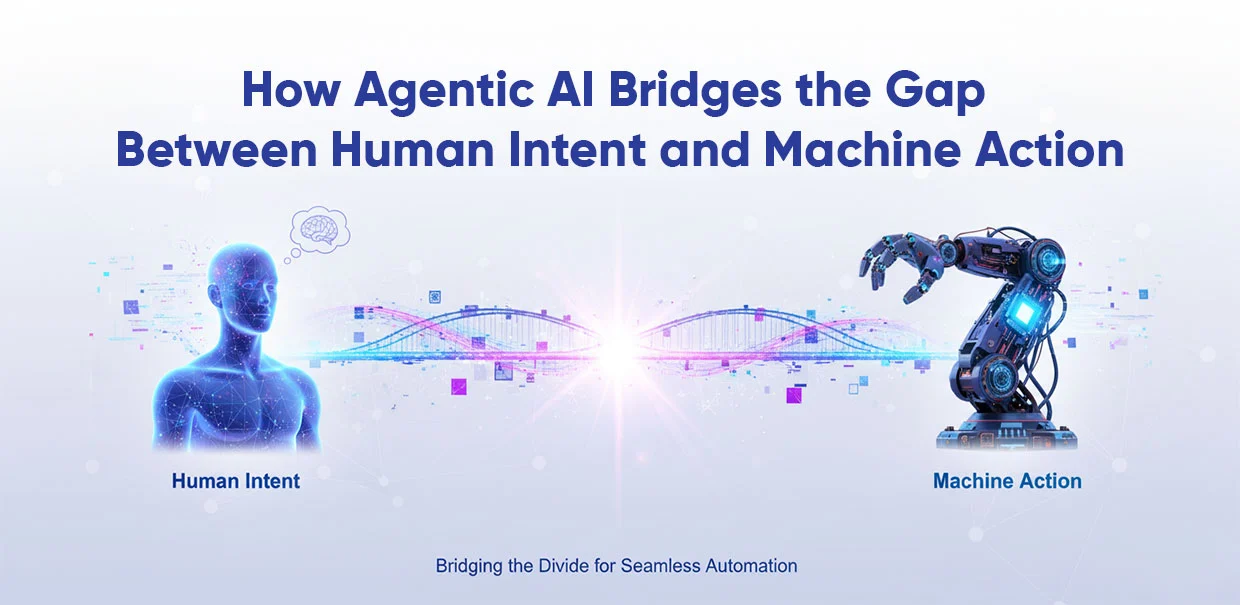
Artificial Intelligence (AI) has evolved far beyond rule-based systems and predictive analytics. Today, we stand at the dawn of a new era powered by agentic AI, intelligent agents capable of understanding human intent, reasoning autonomously, and executing tasks without constant supervision. Unlike traditional AI models that rely heavily on static instructions or pre-trained responses, intelligent agent systems are designed to act, decide, and adapt dynamically, effectively bridging the gap between what humans want and what machines can do.
In this blog, we’ll explore how Agentic AI enables machines to understand human goals, take initiative, and deliver outcomes that align with real-world intent. We’ll also uncover how this technology is revolutionizing industries and redefining the way enterprises approach automation and decision-making.
What Is Agentic AI?
Agentic AI refers to AI systems with autonomous decision-making capabilities, often called AI agents, that can perform complex tasks by understanding goals, planning actions, and learning from outcomes. Instead of waiting for human commands, these intelligent agents can take initiative, adapt to changing contexts, and collaborate with other systems to achieve desired results.
In simple terms, while traditional AI answers questions, an AI agent takes action.
For example:
- A standard AI chatbot may provide predefined responses.
- An AI agent can autonomously access company databases, summarize data, and perform transactions based on user requests, just like a digital employee.
From Automation to Autonomy: The Big Shift
Traditional AI and automation tools are limited to task-based execution; they perform what they’re explicitly programmed to do. Autonomous AI, however, represents a shift from automation to autonomy.
It introduces reasoning and self-direction into the mix. These AI agents can:
- Understand the human intent behind a request.
- Analyze context and dependencies.
- Plan multi-step actions to achieve a goal.
- Monitor progress and adapt if conditions change.
This means businesses can finally go beyond static workflows and experience dynamic, outcome-driven automation, where machines don’t just follow commands but truly understand and deliver results.
Bridging the Gap Between Human Intent and Machine Action
The true innovation lies in how these systems interpret human intent and translate it into meaningful machine-driven actions. Here’s how this bridge is built:
1. Understanding Intent Through Natural Language and Context
Intelligent agents leverage natural language processing (NLP) and contextual understanding to decode human intent. When a user gives a command, “Optimize next month’s marketing spend,” for example, the AI doesn’t just take the words literally. It interprets what the user is trying to achieve, pulls relevant data, and plans the best course of action.
By understanding the why behind a request, an agent transforms casual human input into actionable tasks.
2. Goal-Oriented Reasoning and Planning
Once the intent is clear, the AI assistant uses goal-based reasoning and task decomposition to map out the path to success. These agents can break complex objectives into smaller, manageable subtasks, set priorities, and determine dependencies, just like a human project manager would.
For example, an AI assistant managing a product launch could independently plan content rollout, monitor performance metrics, and adjust strategy in real time based on outcomes.
3. Autonomous Execution and Coordination
Agentic AI integrates with multiple systems, CRM, ERP, cloud platforms, and APIs to perform actions autonomously. It doesn’t just recommend next steps; it executes them. These agents can book meetings, send reports, optimize workflows, or trigger alerts without human oversight.
This turns passive AI assistants into active digital co-workers, reducing manual intervention and accelerating decision cycles.
4. Continuous Learning and Adaptation
Unlike rule-based automation, these systems learn from every action. Through reinforcement learning and feedback loops, it continuously refines its strategies to achieve better results. If a chosen path fails, the AI agent adapts, exploring alternative methods, mirroring the human process of learning through experience.
This continuous improvement makes operations smarter, more efficient, and better aligned with organizational goals over time.
Real-World Applications Across Industries
The potential applications of these intelligent agents span multiple sectors, transforming everyday operations into intelligent ecosystems.
1. Enterprise Operations
In corporate environments, autonomous agents can monitor KPIs, automate report generation, schedule meetings, and even allocate resources based on real-time data. This minimizes administrative overhead and allows leaders to focus on strategy instead of coordination.
2. Customer Support
Instead of static chatbots, companies now deploy AI-powered customer agents that can resolve issues, update CRM records, and escalate complex queries without human involvement, reducing response times and improving customer satisfaction.
3. Marketing and Sales Automation
Intelligent automation tools can autonomously analyze campaign performance, optimize ad budgets, and identify high-potential leads. It helps marketers align execution with customer behavior and business goals, ensuring every dollar spent drives measurable ROI.
4. Manufacturing and Supply Chain
In industries like manufacturing, autonomous agents can monitor supply chain variables, forecast disruptions, and make procurement decisions autonomously. This level of operational intelligence ensures cost efficiency, resilience, and just-in-time delivery.
5. IT and DevOps
Autonomous AI can act as a virtual site reliability engineer (SRE), automatically detecting system anomalies, deploying patches, or scaling infrastructure based on workload patterns. This minimizes downtime and improves system performance.
Key Business Benefits
Adopting these AI-driven systems can deliver wide-ranging organizational benefits:
- Reduced Operational Costs – Autonomous agents handle repetitive and complex tasks, minimizing human effort.
- Faster Decision-Making – AI-driven reasoning ensures real-time, data-backed decisions.
- Scalability – Agentic systems can manage thousands of concurrent tasks without fatigue or error.
- Human-AI Collaboration – Employees can delegate routine work and focus on innovation and problem-solving.
- Better Customer Experience – Intelligent, context-aware interactions lead to personalized engagement.
Essentially, AI enables organizations to turn automation into intelligent orchestration, driving both efficiency and innovation.
Challenges and Ethical Considerations
While promising, AI isn’t without challenges. Businesses must address:
- Transparency and Explainability: Ensuring AI agents’ decisions can be understood and audited.
- Data Privacy and Compliance: Protecting sensitive data while enabling AI autonomy.
- Accountability: Defining human oversight to prevent unintended outcomes or biases.
Organizations must balance autonomy with governance to ensure safe and ethical deployment.
The Future: From Intelligent Systems to Autonomous Enterprises
As Agentic AI continues to evolve, we’re moving closer to the vision of fully autonomous enterprises where digital agents manage workflows, optimize resources, and collaborate seamlessly with humans. With frameworks like multi-agent systems, retrieval-augmented reasoning, and self-reflective AI, these systems will become even more capable and self-sufficient.
Businesses that embrace this transformation early will gain a competitive edge, achieving not just efficiency but intelligent autonomy that aligns seamlessly with business intent.
In Summary
Agentic AI represents the next frontier in artificial intelligence, a leap from passive automation to proactive intelligence. By understanding human intent, reasoning autonomously, and acting decisively, it bridges the long-standing gap between what humans envision and what machines can execute.
The future of business belongs to those who understand how to make this partnership work, where human intent meets intelligent action.

 Sep 22, 2026

