


Justice Gets a Tech Upgrade: What They’re Not Telling You About AI in Courts
 Dec 21,2025
 By Priyanka Shinde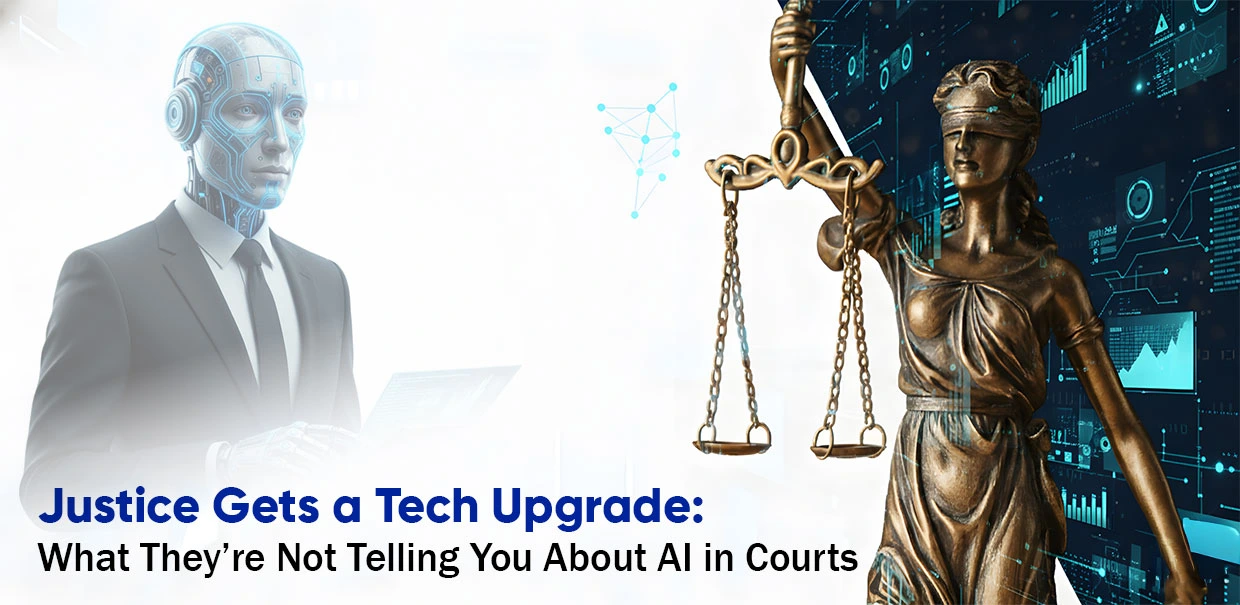
Introduction: The New Face of Justice
Imagine walking into a courtroom not just filled with lawyers and judges, but algorithms. Sounds futuristic? It’s happening right now. Artificial Intelligence (AI) is quietly reshaping how justice is served around the world. From case management to predicting recidivism, AI is entering one of the most human institutions we know: the courts.
But while the headlines boast about efficiency and automation, there’s much more happening behind the scenes. The story of AI in justice isn’t just about technology; it’s about trust, fairness, and the delicate balance between human judgment and machine precision. Learn more about how agentic AI bridges the gap between human intent and machine action.
So, what’s really going on inside these “smart” courts? Let’s pull back the curtain.
The Rise of AI in the Justice System
The legal system has always been known for its heavy paperwork, lengthy trials, and human bias. Enter AI, the game-changer. Over the past few years, governments and court systems across the U.S., Europe, and Asia have been investing in AI tools designed to make judicial processes faster, more accurate, and transparent.
Here’s where AI is making waves:
- Case Management Systems: AI-powered platforms help judges and clerks manage case backlogs by automatically categorizing, prioritizing, and scheduling hearings.
- Legal Research: Lawyers now use AI-driven research assistants like ROSS Intelligence or Casetext to find relevant precedents in seconds, which once took hours or days.
- Predictive Analytics: Courts are experimenting with algorithms that estimate the likelihood of reoffending, guiding bail and sentencing decisions.
- Document Review and e-Discovery: AI tools can sift through millions of pages of evidence, detecting patterns or inconsistencies faster than any human could.
Sounds impressive, right? But here’s the catch: AI in courts is not just about saving time. It’s reshaping how decisions are made, and that comes with powerful implications.
Behind the Bench: What AI Is Actually Doing
Most people don’t realize just how deeply AI has integrated into judicial processes. It’s not just helping with paperwork; it’s quietly influencing who gets bail, how long someone is sentenced, and even what cases get prioritized.
One example is COMPAS (Correctional Offender Management Profiling for Alternative Sanctions), an AI system used in several U.S. states to assess the risk of reoffending. Judges have used its risk scores to guide sentencing decisions. But investigations revealed something alarming: the algorithm often reflected racial biases present in the historical data it was trained on.
AI learns from past cases, and if history was biased, the system might carry that forward, only faster and more efficiently.
That’s the paradox: AI can remove human emotion but not human bias.
Efficiency vs. Fairness: The Great Debate
Supporters argue that AI brings much-needed efficiency and consistency to the legal system. Courts overloaded with cases can use algorithms to speed up decision-making and allocate resources more efficiently.
But critics warn that the very essence of justice, empathy, context, and moral reasoning cannot be automated.
For instance, AI doesn’t understand when a mother steals food out of desperation or when an honest mistake leads to a traffic violation. Humans can see the “why” behind actions; AI can only see data.
The key question becomes: Do we want justice that’s fast or justice that’s fair?
How AI Is Helping Judges and Lawyers
Not all AI interventions are controversial. In fact, many are empowering legal professionals rather than replacing them. Here’s how:
- Smart Research Tools: AI tools can analyze thousands of cases in seconds, spotting arguments or precedents that humans might miss. This allows lawyers to focus more on strategy and client interaction.
- Predictive Case Outcomes: By analyzing similar past cases, AI can give lawyers insights into likely outcomes, helping them craft stronger arguments or negotiate better settlements.
- Courtroom Transcription: Real-time AI transcription tools now record and summarize hearings with near-perfect accuracy, saving hours of clerical work.
- Judgment Summarization: AI can summarize lengthy judgments into concise, understandable summaries for faster interpretation.
When used responsibly, AI isn’t replacing judges; it’s giving them sharper tools.
The Global Picture: How Other Nations Are Experimenting
AI in courts isn’t just a U.S. experiment. Around the world, justice systems are getting smarter:
- China: The country has developed “Smart Courts,” where virtual judges powered by AI handle minor civil disputes entirely online.
- Estonia: This small European nation is piloting AI judges for small claims cases under €7,000.
- India: Courts are exploring AI for digitizing case files and reducing backlog—an important step in a country where millions of cases are pending.
- United Kingdom: The judiciary is using AI to transcribe hearings and assist in legal research, freeing human judges for more complex reasoning.
Each experiment brings a new insight but also raises new questions about transparency, accountability, and bias.
The Dark Side: What They’re Not Telling You
Here’s the part that rarely makes it to the headlines: AI’s role in the courtroom is largely unregulated.
There are no universally accepted standards on how algorithms should be trained, audited, or explained in court. Most defendants never even know that an algorithm influenced their bail or sentencing.
That’s why many experts are calling for “algorithmic transparency,” a principle that requires all AI systems used in justice to be explainable, auditable, and free from discrimination. Because when justice goes digital, we must ensure it remains just.
And then there’s the data problem. The legal system relies on mountains of historical data, often biased, incomplete, or skewed toward certain populations. Feeding this data into AI creates what’s known as “automated inequality.”
In short: AI can amplify the very problems it’s trying to solve if we’re not careful.
The Future: AI + Human Collaboration
The real future of justice isn’t man versus machine; it’s man with machine.
AI can handle the repetitive, data-heavy tasks, freeing up judges and lawyers to focus on empathy, reasoning, and fairness. Imagine a future where AI gives judges an unbiased view of all the facts, but the final call always rests with a human being.
This hybrid model, AI assisting human judgment, is already gaining traction. Experts call it “augmented justice” rather than “automated justice.”
The goal isn’t to replace human wisdom, but to empower it.
Conclusion: Justice, Upgraded, but Still Human
AI is transforming the courtroom into a place where decisions are data-driven, faster, and potentially more consistent. But with that power comes responsibility.
As we welcome AI into our courts, we must ask the hard questions:
Who designs these algorithms? Who ensures they’re fair? And most importantly, who’s accountable when the system gets it wrong?
Justice is not just about logic; it’s about humanity. And no matter how smart the machines become, the heart of justice must remain human.
Because at the end of the day, the true measure of progress isn’t how efficiently we deliver justice, but how fairly we do it.

 Sep 22, 2026

