

From Chaos to Control: How AI Predicts Business Problems Before They Happen
 Dec 22,2025
 By Priyanka Shinde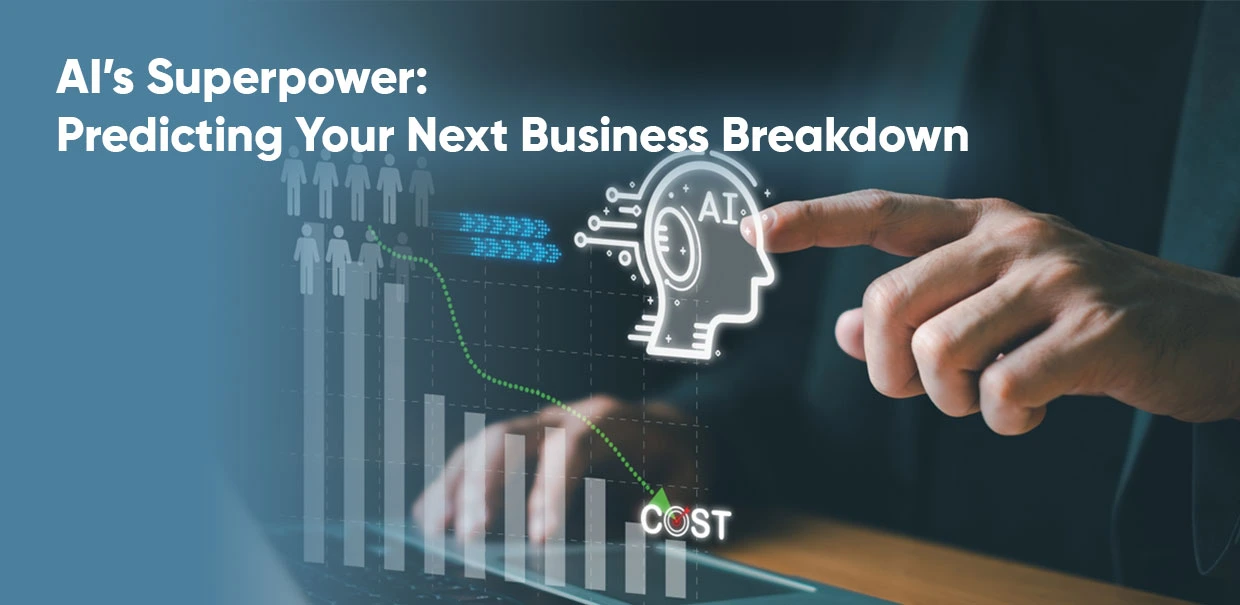
Businesses today don’t fail because they lack data; they fail because they can’t make sense of it fast enough. Markets change overnight, customers switch preferences in a blink, supply chains break without warning, and small operational cracks quietly grow into costly disasters.
For decades, companies have tried to manage this chaos with reports, dashboards, and endless Excel sheets. But by the time humans detect a problem, the damage is often done.
That’s where AI steps in, not as a reactive tool, but as a predictive engine that warns you before things go wrong.
Welcome to the era where AI turns chaos into control. And the transformation is bigger than you think.
The Business World Is Becoming Too Fast for Humans to Keep Up
Every modern company, no matter the industry, is drowning in data:
- Customer interactions
- Sales patterns
- Inventory movement
- Market shifts
- Employee performance
- Machine operations
- Financial transactions
The problem isn’t data availability.
The problem is the speed at which patterns change.
By the time a human notices declining sales, customer churn, delayed shipments, financial discrepancies, or machine anomalies… the opportunity to prevent loss is already gone.
This lag between problem forming and problem being detected is what AI eliminates.
AI doesn’t just analyze what has happened; it analyzes what will happen next.
Predictive AI: Your Business Crystal Ball
Imagine having a system that:
- Alerts you about a customer likely to churn… before they cancel the service.
- Flags a machine that will break down… before it shuts down your production line.
- Detects suspicious financial activity… before it becomes a fraud case.
- Suggests hiring needs… before your team hits a workload crisis.
- Identifies product shortages… before customers complain.
This is exactly what predictive AI enables.
It continuously reads millions of data points—something no human or traditional software can do—and identifies patterns that signal future outcomes.
The secret?
AI doesn’t get distracted.
AI doesn’t get tired.
AI doesn’t miss patterns.
It looks at everything, all the time.
5 Major Areas Where AI Predicts Business Problems Before They Happen
1. Predicting Operational Breakdowns
Operational disruptions—equipment failure, process bottlenecks, and resource shortages—are extremely costly.
AI-powered predictive analytics can analyze:
- Machine temperature
- Vibration levels
- Historical breakdown data
- Operator logs
- Energy consumption
With this, AI warns companies weeks in advance if a machine is nearing failure.
This means:
✔ Less downtime
✔ Lower maintenance costs
✔ Longer equipment life
✔ Zero surprise breakdowns
This is why predictive maintenance is now one of the biggest use cases in manufacturing, logistics, energy, and construction.
2. Predicting Customer Behavior and Churn
Your customers rarely leave suddenly.
They give subtle signals long before:
- Reduced login frequency
- Declining purchase value
- Negative support interactions
- Browsing without buying
- Cart abandonment
AI detects these patterns and alerts your teams so they can intervene before the customer disappears.
Imagine knowing:
- Which customers need discounts
- Which needs better support
- Which are about to stop buying
- Which products are they likely to buy next
This shifts your business from reaction to proactive engagement.
3. Predicting Financial Risks and Irregularities
Money problems often hide in plain sight:
- Unusual transactions
- Billing errors
- Fraud behavior
- Cash flow gaps
- Payroll discrepancies
AI scans documents, invoices, bank data, and financial records with unmatched accuracy.
It not only detects suspicious activities but also forecasts future risks such as:
✔ Liquidity shortages
✔ Budget overshooting
✔ Revenue decline
✔ High-risk vendors
It’s like having a 24/7 financial watchdog.
4. Predicting Market Trends Before Competitors Do
AI helps businesses stay ahead by analyzing:
- Social media sentiment
- Customer conversations
- Search trends
- Competitor activity
- Demographic shifts
- Regional demands
Instead of waiting for the market to change, companies start preparing months earlier.
They can launch products ahead of demand, adjust pricing, and align inventory based on future trends—not historical data.
This is how small businesses compete with giants.
5. Predicting Employee Performance Issues & Workforce Needs
People-related challenges—burnout, attrition, low productivity—hurt business silently.
AI can identify:
- Workload stress levels
- Drop in performance metrics
- Team communication gaps
- Skill shortages
- High-risk employees are likely to quit
This allows HR and leaders to act early, creating healthier, more productive workplaces.
AI doesn’t replace human judgment but it gives leaders the insights they need to make better decisions.
How AI Turns Raw Data Into Actionable Predictions
AI prediction works through three powerful mechanisms:
1. Pattern Recognition
AI identifies trends humans can’t see.
For example, a drop in customer satisfaction + delayed deliveries + increased refund requests = potential churn spike.
2. Anomaly Detection
AI flags anything that deviates from normal behavior.
Even the smallest irregularity is caught in real time.
3. Forecasting Models
AI learns from historical data to predict future outcomes
(sales, breakdowns, prices, market demands).
This combination gives businesses a crystal-clear view of what’s coming next.
Why Businesses Trust AI Over Traditional Systems
Traditional analytics tells you what happened yesterday.
AI tells you what will happen tomorrow.
Here’s why companies prefer AI:
- Real-time insights
- Better accuracy than manual analysis
- Covers all data sources, not just a subset
- Continuous learning—gets smarter over time
- Fast response—predictions in milliseconds
- No human bias
Most importantly, AI prevents losses instead of reporting them after the damage is done.
Real-Life Example: The Power of Early Prediction
Let’s take a common scenario:
A retailer usually faces stockouts during festive seasons.
By the time they realize demand is rising, it’s too late—the shelves are empty, and customers leave unsatisfied.
With AI:
- It predicts which products will spike in demand
- Highlights low inventory weeks in advance
- Recommends reorder quantities
- Identifies which stores will face shortages
Result?
✔ No stockouts
✔ Higher sales
✔ Better customer experience
✔ Zero last-minute panic
This is the difference between guessing and knowing.
The Future: AI as a Business Co-Pilot
We’re entering a world where AI becomes a business partner, not just a tool.
Soon, AI will:
- Schedule your operations automatically
- Recommend business strategies
- Predict competitor moves
- Flag legal and compliance risks
- Provide real-time decision support
Imagine running a business where your AI co-pilot whispers:
“You’re about to lose a major client; take action.”
“You’re inventory will run out in 5 days.”
“Your revenue will drop next quarter if you don’t adjust pricing.”
“This vendor’s pattern looks suspicious.”
This kind of clarity transforms everything.
Conclusion: Chaos Doesn’t Stand a Chance
Businesses don’t need more tools; they need foresight.
They need systems that warn them early so they can act fast and smart.
AI gives companies an unfair advantage:
- More control
- Fewer surprises
- Better decisions
- Lower costs
- Stronger efficiency
- Higher scalability
From chaos to control, AI is reshaping the way businesses operate.
And those who adopt predictive AI now won’t just avoid problems—they’ll outsmart them.

 Sep 22, 2026

