

AI-Powered Property
Operations & Maintenance

Connect service requests, asset history, SLA rules, vendor availability, work orders and inspection evidence to prioritize maintenance, predict service needs and close the loop in property systems.

Business challenge

Property Operations Lose Time When Service Requests, Asset Data and Vendor Execution Are Disconnected

Facilities teams often manage tenant requests, asset history, inspection notes, vendor capacity, service-level commitments and maintenance schedules across separate tools. Manual coordination makes prioritization inconsistent, increases follow-up effort and limits the ability to shift from reactive maintenance toward data-driven, condition-based intervention.

Common challenges include:

  • Multiple request channels: Sales Maintenance requests and facilities work orders can arrive from tenants, property staff and operational systems.
  • Incomplete context at intake: Teams may need to manually retrieve asset history, tenant details and previous work before a request can be assessed.
  • Manual priority and SLA triage: Urgency, service commitments and issue type must be considered before routing the work.
  • Vendor coordination effort: Matching the right vendor and scheduling service can require repeated communication and follow-up.
  • Limited closure visibility: Inspection notes, completion evidence and final status need to be consolidated for reporting and future asset history.

Intelligent Work-Order Orchestration with Predictive Maintenance Context

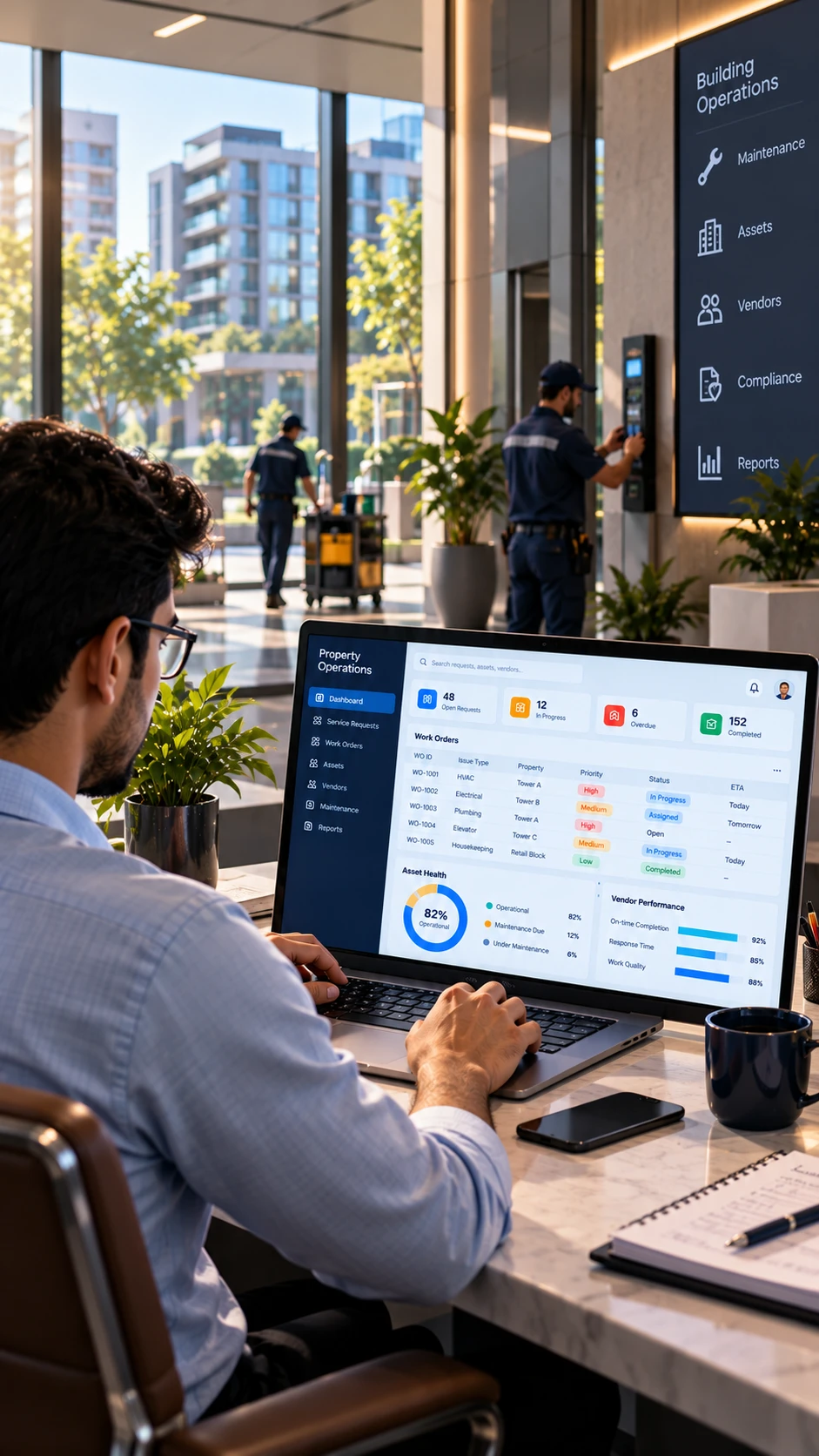
The workflow centralizes request intake, enriches each case with asset and tenant context, applies SLA and risk rules, recommends vendor or technician routing and uses maintenance history to support predictive scheduling. Managers retain approval for material work, while completion evidence and service outcomes are written back to the property or CMMS platform.

The solution uses:

  • Automated work-order intake: Capture maintenance and facilities requests into a consistent workflow.
  • Asset and tenant context retrieval: Pull property, asset, tenant and prior-service information needed for assessment.
  • Priority and SLA triage: Apply rules to determine urgency, service targets and routing requirements.
  • Vendor match and scheduling: Coordinate an appropriate service provider based on request type and operational rules.
  • AI-generated work summary: Provide the property manager with a concise brief covering issue, context, priority and planned action.
  • Manager review and approval: Keep authorization, exceptions and escalations under property-management review.
  • Closure and reporting: Capture completion status, inspection notes and operational reporting in the property system.
Smarter invoice processing solution

Quantified Evidence for Predictive Property Maintenance

Results

10–20% lower maintenance cost

Commercial-real-estate AI operating models identify predictive maintenance as a mature use case with realistic maintenance-cost savings in this range.

10–20% higher equipment uptime

Predictive maintenance can improve asset uptime and availability by moving intervention closer to actual condition.

20–50% less maintenance-planning time

Predictive maintenance can materially reduce the effort required to plan maintenance activities.

From Reactive Facilities Coordination to Predictive,
SLA-Led Property Operations

The operating model moves from manual dispatch and after-the-fact follow-up to prioritized, evidence-based maintenance. Asset context, service history, predictive signals and SLA logic guide the work queue, while people remain responsible for exceptions, approvals and high-impact service decisions.

    The workflow

    How AI-Powered Property Operations & Maintenance Works

    The workflow connects work-order intake, asset context, SLA triage, vendor scheduling, AI-assisted work summarization, manager control and property-system closure.

    01 INTAKE

    Work Order Intake

    A maintenance or facilities request enters the workflow from a tenant, property team or service channel.

    • Issue description and request type
    • Property / unit information
    • Requested service or reported problem

    Technology / System: Work-Order Orchestration

    02 CONTEXT

    Asset & Tenant Context Pull

    The workflow gathers the information needed to understand the request before it is prioritized.

    • Asset history
    • Tenant or occupancy details
    • Previous work orders and inspection notes

    Technology / System: CMMS / Asset + Tenant Data

    03 TRIAGE

    Priority / SLA Triage

    Rules classify the request by urgency, impact and service-level commitments.

    • Priority level
    • SLA target
    • Routing or escalation requirement

    Technology / System: SLA Rules / Priority Engine

    04 COORDINATE

    Vendor Match & Scheduling

    The workflow identifies an appropriate vendor or service provider and coordinates the next available action.

    • Vendor capability
    • Availability and location
    • Scheduling requirement

    Technology / System: Vendor Routing / Scheduling

    05 SUMMARIZE

    GenAI Work Summary

    Generative AI prepares a concise work summary for property-management review.

    • Issue and property context
    • Priority and SLA status
    • Recommended vendor / scheduled action

    Technology / System: GenAI Work Brief

    06 APPROVE

    Manager Review & Approval

    The property manager reviews the planned response and resolves exceptions, approvals or escalation needs.

    • Approve vendor / action
    • Adjust priority or schedule
    • Escalate where required

    Technology / System: Facilities Manager Review

    07 CLOSE

    Closure & Reporting

    Completed work is closed with status, notes and evidence captured for reporting and future asset history.

    • Completion status
    • Inspection or service notes
    • SLA and operational reporting

    Technology / System: CMMS / Property Management System